.
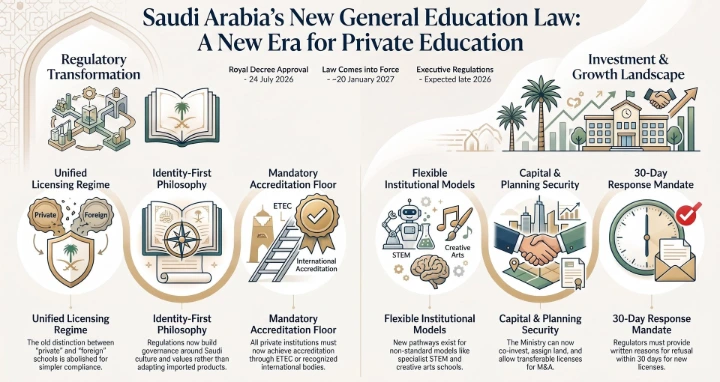
On 24 July 2026, a royal decree approved the Kingdom's first comprehensive legal framework for pre-university education. Sixty-eight articles covering everything from early years provision to private school licensing. It comes into force roughly 180 days after publication, around 20 January 2027, with executive regulations still to follow.
"For years, I watched international curriculum delivery in Saudi Arabia unfold the same way: an imported product, built elsewhere and layered onto the local market, and never designed with the culture or the student in mind."
I've spent close to two decades working across international education, and I've watched how international curriculum delivery in Saudi Arabia actually happened on the ground: it was largely an imported product, built elsewhere and layered onto the local market, rather than something designed with the culture and the student in mind. This law is the first real attempt to reverse that. It puts the student and Saudi identity, (values and language at the centre of the framework, then builds governance, licensing and investment rules around that core rather than the other way around. That's a meaningful shift in philosophy, not just paperwork.
What actually changes for the private sector
A few provisions stand out for operators, both local and international:
- One institution category, not two. The old split between "private" and "foreign" schools is gone. Every private and non-profit institution now sits under a single licensing and compliance regime. Simpler to navigate, easier to plan around.
- Room for non-standard models. A new article allows licensing for institutions that don't fit the traditional mould, special needs networks, sixth-form pathways, specialist STEM or creative arts schools, with a mandated 30-day response window, written reasons for refusal, and a right of appeal. That's a regulator setting real deadlines for itself.
- Accreditation becomes a floor, not an option. Every private institution will need accreditation from ETEC or a recognised international body. Institutions already operating to strong standards will find most of this is simply their existing practice, now written into law.
- Capital can plan. The Ministry can co-invest, assign land and buildings, and contract private or foreign investors to build and operate schools. Fee-setting also moves from case-by-case approval to a published standard, within which institutions set their own pricing.
- Licences are transferable, with Ministry approval, a detail that matters more than it looks for M&A and long-term investment planning.
The growth areas to watch are early childhood education, special educational needs, gifted and talented programmes, and specialist international curriculum schools, all explicitly called out as priorities.
What's next
For anyone operating or investing in this market, the executive regulations are where the real detail will land. Five workstreams are worth tracking closely: fee-adjustment standards, accreditation transition rules for existing schools, the approval process for international programmes and curricula, student rights and complaint handling, and the classification of penalties for non-compliance.
None of this changes what happens in a classroom tomorrow. But it changes the rules institutions and investors will be planning around for the next decade — and for the first time, it does so with a framework that was actually built for this market, not adapted to it after the fact.tart writing here...