
Saudi Arabia isn't following the global skills-first trend. It's accelerating past it.
.
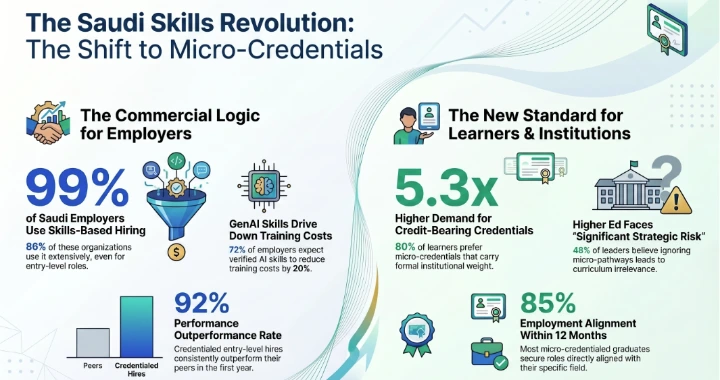
We've been watching the Kingdom's labour market shift for several years now, and the latest Coursera's Micro-Credential Impact Report confirms what many of us working across MENA have observed on the ground: the degree-only hiring model is functionally over in Saudi Arabia.
The numbers tell a clear story. 99% of Saudi employers now use skills-based hiring in some form, 86% extensively, even at the entry level. But what stands out isn't the adoption rate. It's the commercial logic behind it:
- 72% of Saudi employers expect that hiring candidates with verified GenAI skills will reduce training costs by more than 20%. That's not a talent philosophy. That's a P&L decision.
- The student side of the equation is equally telling. Saudi learners are 5.3 times more likely to pursue a micro-credential when it carries formal credit recognition, 80% versus just 15% without it. That preference isn't about convenience. It reflects a deeply held value for credentials that carry institutional weight in both academic and professional contexts.
In this market, the badge alone isn't enough anymore. It needs to mean something inside the system.
For institutions still treating micro-credentials as a value-add rather than a core offering, the data is a direct warning: 48% of higher education leaders in Saudi Arabia believe that institutions failing to embed these pathways face moderate to significant strategic risk, including weaker employer signalling and slower curriculum relevance.
The performance outcomes are the part I find most credible. 92% of Saudi employers report that entry-level hires with micro-credentials outperformed peers in their first year. 85% of those graduates secured roles aligned with their field within 12 months. When both sides of the market report results that consistent, that's not a trend, that's a structural shift.
The institutions building joint-designed, credit-bearing programs with industry today will be setting the standard when Vision 2030 workforce targets intensify. Watching isn't a strategy.
What's your read on the pace of institutional response across the GCC, are universities keeping up, or are employers starting to build their own pipelines?