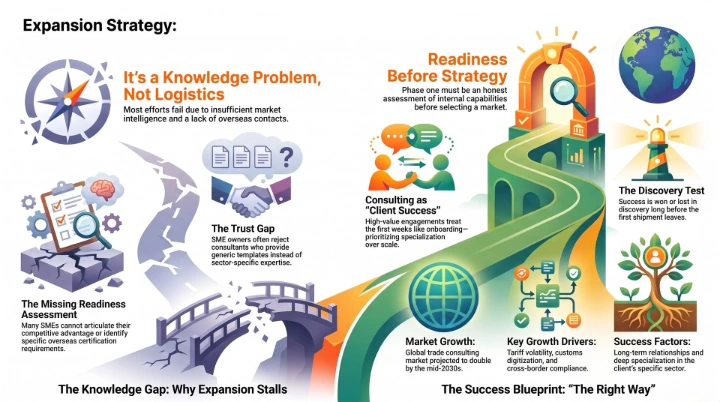
Cross-border trade, capital, and information flows are at a record high, despite tariffs being back in the headlines and "reshoring" trending on every second LinkedIn post. The opportunity for international expansion hasn't shrunk. It's become increasingly challenging to navigate effectively — and that's precisely why trade consulting is experiencing rapid growth, with the global market projected to nearly double by the mid-2030s, driven by tariff volatility, customs digitization, and cross-border compliance.
Small and mid-sized businesses are driving a large share of that growth. They want to trade internationally. They rarely have the in-house expertise to do it well. That gap between ambition and capability is where a consultant is supposed to add value.
So why do so many SME expansion efforts still fail?
The failure point isn't logistics. It's understanding.
I've reviewed the research on this more than once, and the pattern holds every time. SME export efforts stall less because of shipping, customs paperwork, or financing, and more because of insufficient market knowledge, limited international experience, and a lack of overseas contacts and business intelligence. Studies from the Inter-American Development Bank go further: many exporting SMEs can't reliably identify the right markets, design a workable entry strategy, or even articulate what makes their product competitive abroad, including packaging standards, certifications, and market-specific requirements that never come up in a domestic sale.
None of that is a logistics problem. It's a needs-understanding problem. It's precisely the gap a trade consultant exists to close, if the engagement is built the right way.
What "the right way" actually looks like
The IDB research is useful because it doesn't stop at diagnosis. In the engagement models that work, the first stage isn't a market recommendation. It's an honest assessment of the firm's export readiness, its actual capabilities and constraints, before any market gets selected.
That sequencing matters more than it sounds. A consultant who leads with a market recommendation is selling a product. A consultant who leads with a readiness assessment is doing client success work: understanding goals and internal capability before prescribing a direction. I've seen this exact distinction separate consultants who get renewed from consultants who get a polite thank-you after phase one. The strategy is only as good as the discovery that preceded it.
The part most trade consultants don't want to talk about
Here's the uncomfortable finding worth naming directly. The gap between SMEs and the consultancy market isn't just a supply problem — it's weak demand from SME owners themselves, many of whom are reluctant to trust an outside consultant. And the research suggests the consultant side earns that skepticism: a genuine lack of understanding of what SMEs actually need.
The same research, looking at SME consulting relationships in France, found the two factors most associated with lasting engagements were a long-term relationship and real specialization in the client's specific sector. Not a broader service catalog. Not a bigger brand name. Depth of understanding in the client's actual world.
That should reframe how consultants think about their own value proposition. SMEs aren't rejecting expertise. They're rejecting generic engagement , the kind where a consultant shows up with a market entry template built for a different industry and a different client, and expects it to fit.
Client success is the missing layer in trade consulting
Put these findings together, and the picture is clear. The market opportunity is real and growing. The client's need is real, and probably understated. But the trust gap persists because too many engagements skip the step that actually builds trust: a genuine, sector-specific understanding of where the client stands before recommending where they should go.
This is, functionally, a client success discipline applied to trade consulting. The consultants who move clients successfully into new markets aren't the ones with the most polished market entry deck. They're the ones who treat the first weeks of an engagement the way a strong CS team treats onboarding — readiness before strategy, specialization before scale, a relationship built on specificity rather than a template.
For any business considering international expansion, that's the question worth asking a consultant before signing: What will you learn about my business before you tell me which market to enter?
If the answer is vague, that's the gap the research points to. If the answer is specific, that's a consultant who understands global expansion is won or lost in discovery, long before the first shipment leaves the warehouse.
Sources: DHL Global Connectedness Report 2026 (DHL & NYU Stern); MarkWide Research, Trade Consulting Service Market Forecast 2026–2036; Verified Market Reports, Global Trade Consulting Service Market Forecast; Elsharnouby et al. (2024), Humanities and Social Sciences Communications; IDB working paper, "Supporting SMEs to Export"; Revue de l'Entrepreneuriat, "The difficult relationship between the consultancy market and SMEs"